If you’ve ever bought something from a friend’s recommendation in a group chat, joined a live product demo on social media, or been invited to a “party” (online or in someone’s home) to try a product—then you’ve already brushed up against direct selling.
This business model can be legitimate. It can also be confusing, especially because people often mix it up with multi-level marketing (MLM), and then confuse MLM with pyramid schemes.
This guide is for beginners. You don’t need a sales background to follow it.
What is direct selling?
Direct selling is a business model where products or services are sold directly to consumers, usually outside a fixed retail store, often through independent representatives.
Instead of buying from a store shelf, you buy from a person (in person or online) who represents the company’s products.
You’ll see it show up in a few modern forms:
- A rep selling through social media DMs or live streams
- In-home or small-group product demonstrations (the classic “party plan”)
- Local community events and pop-ups
- Referral-based selling driven by personal networks
For a plain-English overview of the model, see Salesforce’s explainer on direct selling (Salesforce, 2024).
How This Model Works
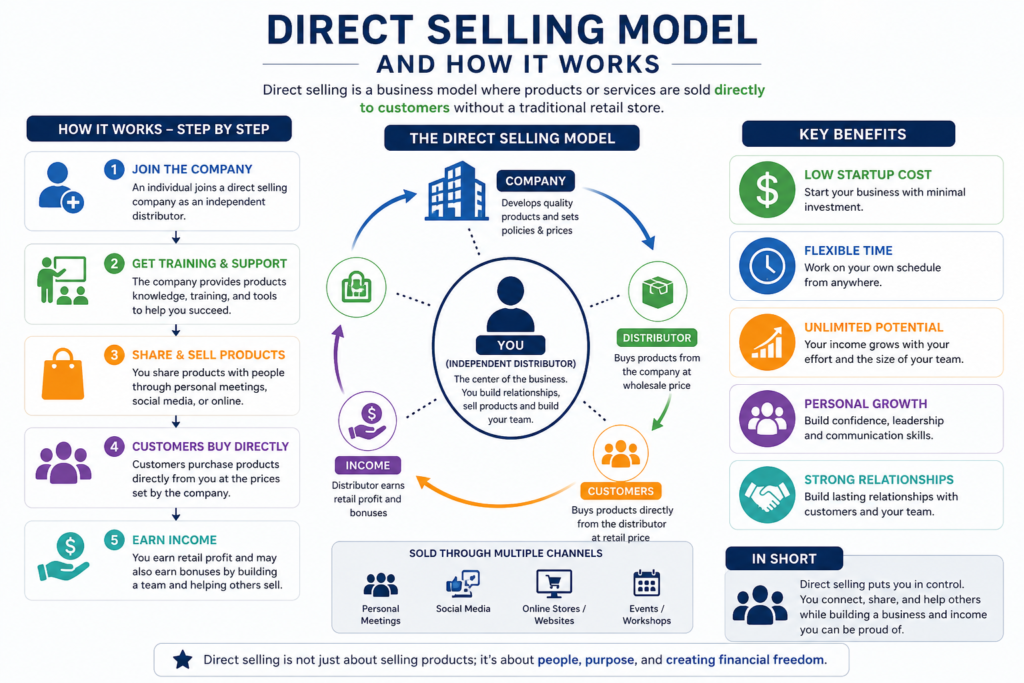
If you’re searching for “how does direct selling work,” here’s the simple version.
At its simplest, it has three moving parts:
- The company creates the product (or sources it) and sets policies.
- The seller/representative markets and sells to customers.
- The customer buys for personal use.
Depending on the company, a seller might:
- Earn a commission on each sale
- Buy products at a discount and resell them (sometimes described as wholesale-to-retail)
- Use a personal link or code that tracks the sale
Why do companies use this approach? Because it replaces traditional retail distribution with relationship-based selling and community marketing.
That human element can be a strength (trust, personalized help) or a weakness (pressure, blurred boundaries, misinformation). A lot depends on the company’s rules and how sellers are encouraged to behave.
The main models: single-level vs multi-level marketing (MLM)
The Main Models: single-level vs multi-level marketing (MLM)
One of the biggest sources of confusion is that “direct selling” is a broad umbrella. Under that umbrella you’ll find both:
Single-level direct selling (SLM)
In single-level models, sellers earn money from their own sales—and that’s it.
- No recruiting requirement
- No multi-tier commissions
- Usually simpler to understand and easier to evaluate
Multi-level marketing (MLM)
In MLM, sellers can earn money from:
- Their personal sales, and
- A portion of sales made by people they recruit (often called a downline)
That second part—earning from the activity of recruited participants—is what makes MLM controversial and what increases the need for compliance.
If you’ve searched for “multi level marketing vs direct selling,” this is the core distinction: MLM adds a recruitment-linked compensation layer; single-level models don’t.
Key Takeaway: All MLMs are a form of direct selling, but not all direct selling is MLM.
Why some people get into it (and why others avoid it)
People join for real reasons—many of them reasonable.
Common reasons people join
- Flexibility: selling on evenings/weekends, around another job
- Lower barrier to entry: compared to opening a physical store
- Community: some people genuinely enjoy group support and social connection
- Skill-building: communication, marketing, confidence, customer service
- Product affinity: “I like this product and want to recommend it”
Common reasons people avoid it
- Social pressure: friends and family can feel like the customer base
- Uncertain results: sales are rarely predictable early on
- Upfront costs: kits, samples, subscriptions, events, training
- Reputation risk: some categories (especially MLM) carry stigma
- Blurry ethics: exaggerated claims or “hustle culture” behavior
A balanced view matters. If you’re evaluating an opportunity, you want to understand both the upside and the failure modes.
What makes a company more likely to be legitimate?
There’s no single checklist item that guarantees legitimacy—but legitimate businesses tend to share patterns.
1) The product stands on its own
If you removed the “opportunity,” would people still buy the product at its price?
Look for:
- Clear product value (not vague promises)
- Competitive pricing for the category
- Normal return/refund policies
Be cautious if:
- The product seems overpriced for what it is
- Most purchases appear to come from participants rather than customers
2) Compensation is tied to real customer demand
A healthier model rewards genuine sales to end customers.
When compensation shifts heavily toward recruitment fees or forced buying by participants, risk increases.
3) The company is transparent about typical results
Legitimate companies don’t rely on vague “anyone can do this” messaging.
They’re more likely to provide:
- Clear policies on earnings claims
- A realistic explanation of effort required
- Accessible disclosures (including income disclosures where relevant)
4) Policies protect customers and sellers
Look for:
- Buyback or return policies for unsold inventory
- Cooling-off periods (where applicable)
- Clear complaint channels
Direct selling vs pyramid scheme: how to tell the difference
A pyramid scheme generally makes money primarily from recruiting participants and collecting fees or purchases—rather than selling a real product to real customers.
The Federal Trade Commission (FTC) explains warning signs and questions to ask in its consumer guidance, Multi-Level Marketing Businesses and Pyramid Schemes (FTC Consumer Advice, updated 2026).
Here are practical red flags you can use immediately.
Red flag 1: Recruiting feels more important than selling
If conversations constantly come back to:
- “Build your team”
- “Duplicate the system”
- “Just recruit X people”
…but there’s little focus on real customers, that’s a warning sign.
Red flag 2: Pressure to buy inventory you can’t realistically sell
A common trap is buying more than you can move—because incentives are tied to purchase volume, rank, or bonuses.
Red flag 3: Big lifestyle marketing with little evidence
Be cautious when you see:
- Luxury imagery as the core pitch
- “Quit your job” messaging
- Claims that imply typical people achieve high earnings
This guide avoids income claims on purpose: without the full context (costs, time, attrition, typical results), earnings messaging can mislead.
Red flag 4: Vague language, unclear policies, or “don’t be negative” culture
Healthy businesses allow questions.
Be cautious if you’re discouraged from:
- Reading the fine print
- Comparing alternatives
- Asking for documented typical results
⚠️ Warning: If you’re being rushed to sign up or buy before you can read policies and understand costs, slow down.
Costs, risk, and expectation-setting (without the hype)
Even in the best-case scenario, this isn’t “passive.” It’s work.
Before you join anything, get specific about:
- Your fixed costs: starter kit, monthly subscription, website fees
- Your variable costs: samples, shipping, events, mileage
- Time cost: outreach, follow-ups, content creation, customer care
A useful way to stay grounded is to think in milestones:
- Can you find a few customers who buy again?
- Can you explain the product clearly without exaggeration?
- Can you run the activity without damaging relationships?
If the answer to any of those is “no,” you’re not failing—you’re getting useful information early.
How to evaluate an opportunity: a practical checklist
If someone invites you to join (or you’re just curious), use this as your decision framework.
Questions to ask about the product
- Who buys it, and why?
- What problem does it solve in normal, non-miracle terms?
- How does it compare on price and quality to alternatives?
- What’s the refund policy for customers?
Questions to ask about the business model
- How do commissions work on personal sales?
- If it’s MLM: what portion of compensation is tied to product sales vs recruitment?
- Are there monthly purchase requirements to stay “active”?
- Is there a buyback policy for unsold inventory?
Questions to ask about claims and compliance
- What are the rules for income claims and testimonials?
- Is there training on what you can and can’t say?
- Are you encouraged to post lifestyle marketing or earnings hints?
For a deeper look at how the FTC thinks about earnings claims and deceptive practices, read the FTC’s staff guidance, Business Guidance Concerning Multi-Level Marketing (FTC, 2024).
Questions to ask yourself (the most important part)
- Do you actually want to sell to your network, or would that feel uncomfortable?
- Do you enjoy consistent outreach and follow-up?
- Can you afford the costs without relying on future earnings?
- If you earned nothing from recruitment (if MLM), would the model still make sense to you?
The industry in context (a quick, grounded snapshot)
If you’re wondering whether this is a “real” channel: it’s a sizable global industry.
- The World Federation of Direct Selling Associations publishes annual statistics on global activity in its Global Statistics page (WFDSA).
- In the U.S., the Direct Selling Association reported $34.7B in retail sales (2024) in its press release on the 2025 Growth Outlook Study (DSA).
Stats don’t prove legitimacy on their own, but they do show that the channel exists well beyond any single company.
The model’s potential (and its limits)
The potential is real, but it’s not universal.
Where it can work well:
- Products that benefit from demonstration or guidance
- Communities where word-of-mouth trust is strong
- People who enjoy selling and relationship building
Where it tends to go wrong:
- When recruiting becomes the primary engine
- When claims get exaggerated (income, lifestyle, or product effectiveness)
- When people are pressured into spending more than they can afford
If you treat it like a small business—with careful budgeting, ethical marketing, and realistic expectations—you’ll evaluate it more clearly than if you treat it like a shortcut.
FTC-style disclosure and consumer protection note
This article is for general educational purposes.
- No income claims: Any earnings vary widely and depend on many factors (time, skill, market, costs, and the specific company). Be wary of anyone who implies high earnings are typical.
- No health claims: If an organization sells wellness products, avoid making medical claims. Rely on approved, compliant product information and consult qualified professionals for medical decisions.
- Know the rules: In the U.S., the FTC publishes guidance and consumer education on MLM and pyramid schemes. (See the FTC resources linked earlier in this article.)
FAQ (Beginner questions)
Is direct selling legit?
It can be. This model includes both single-level sales and MLM. The legitimacy question usually comes down to whether compensation is driven by real product sales to real customers, whether claims are truthful, and whether costs and policies are transparent.
What’s the difference between direct selling and MLM?
Direct selling is the umbrella. MLM is one type of direct selling where compensation can include commissions based on the sales of recruited participants.
Is direct selling the same as a pyramid scheme?
No—but some pyramid schemes disguise themselves as MLM. A key warning sign is a system that rewards recruitment and participant purchases more than genuine retail sales.
Do you have to recruit people in direct selling?
Not always. In single-level models, you earn from your own sales only. In MLM models, recruiting is often tied to advancement or additional commission streams.
What should I do if I’m interested but unsure?
Start small and slow: read policies, understand costs, ask for written disclosures, and take time to compare alternatives. High-pressure urgency is rarely a good sign.